North Idaho Slow Growth
-
Election Fraud in Kootenai—Questions and Answers
Jan 12, 2025
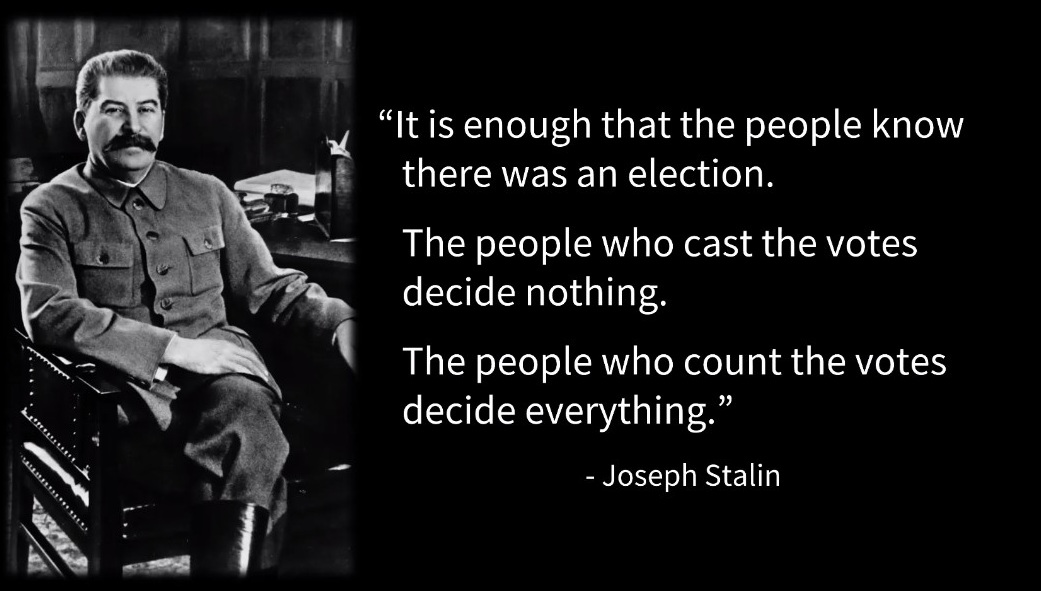
As Stalin famously said, “The people who cast the votes decide nothing. The people who count the votes decide everything.”
So the first question North Idaho residents need to ask is: Who, exactly, is counting our votes?
The short answer is: Kootenai County votes are counted on tabulators that are built, maintained, and operated by an Election Technology Company owned by a private equity firm based in Omaha. The people who “count the votes” are consultants working for an elections services corporation that Kootenai residents know nothing about.
Perhaps it is time that Kootenai residents learned more about their system of elections.
Understanding Kootenai County Elections
Twenty years ago it was very easy for the average person to understand how elections were conducted. Both registration and voting were generally done in person, and voter fraud--if it occurred, would also have to be done in person. Pre-computerized systems of voting were not perfect, but they were comprehensible.
Over the last few decades, however, voter registration, polling, and tabulation systems have all been computerized, and many more levels of bureaucracy, "certification" and "federal oversight" have been added. Now technology companies now have almost total control over our elections, and the same computerized services that help automate elections also makes them less transparent, and more baffling—especially to those who are not computer-savvy.
The truth is, Election fraud is a serious issue in Kootenai County, and all of Idaho. And more people need to understand the problems. The following Questions and Answers summarize are intended to help people recognize the risk of computerized manipulation of our elections and offer ways to address the problem.
The questions are divided into three categories:
- A. Overview of KC's Election System
- B. Risks and Evidence of Election Fraud
- C. Potential Improvements to KC Elections
More detailed NISGR articles on Election Fraud are are listed as resources at the end.
A. Overview of KC's Election System—Q & A
A.1) Who is allowed to Vote in Kootenai County and how are poll records kept?
When Kootenai residents go to their polling stations, they check in by showing a valid ID to a poll worker. An electronic poll-book is used to make sure they are registered to vote, and if so, they sign the poll-book with an electronic signature and are given a ballot. If they are registered to vote, but do not have ID, they are asked sign an affidavit, and if they have ID but are not registered, they are allowed to register. But in either case they are given a ballot.
And all the information about who signed in, registered, and voted, is stored in an electronic "poll-book". No handwritten signature is required, and no paper record of who receive a ballot is maintained. It's all in "the computer".
A.2) What happens to Kootenai ballots after they are cast at Precinct polling stations?
Once a polling station is closed, the ballot box is secured so it cannot be opened until it arrives at the elections office. The number of ballots cast are not counted at the precinct, and the reconciliation with the poll-book numbers, as required by ID 34 1202, occurs at the elections office after tabulation, rather than at the precincts.
Once the precinct ballot box arrives at the elections office it is put in a secured room, and only taken out when the precinct is counted on the central tabulator. The tabulator scans all the ballots, produces "official" ballot images and calculates the number of votes cast in that precinct (which is then reconciled with the electronic poll book numbers). Then the physical ballots are "locked down" so that no one can access them until after the election is certified.
So no human beings, either at the precinct, or in the elections office, are given access to the physical ballots other than the 5-10 minutes they are removed from the ballot box and scanned into the tabultor. So Kootenai elections are decided entirely by machine. No one but the tabulator ever sees the ballots.
A.3) What is the Election Technology Company that serves Kootenai County?
The company that builds, maintains, and operates KC's tabulators is Election Software and Solutions, better known as ESS. It is based in Omaha, and is controlled by a private equity group associated with banks, insurance companies, and railroads. The company that operates Idaho's poll-books is Tenex Software Solutions, a privately held company based in Florida. The financial records of privately held companies, of course, cannot be inspected. But there are really no other options, because all election technology companies are privately owned, and all have similar security and transparency issues.
A.4) How long has Kootenai’s County used ESS tabulators?
Kootenai's First ESS Tabulators were put in place by Dan English (KC Clerk, 1995-2010), soon after the Federal Government passed the Help America Vote Act in 2002. The intent of HAVA was to pursuade local governments across the country to upgrade from manuel to computerized methods of tabulation. Since then, KC has accepted hundreds of thousands of dollars in HAVA funds and upgraded their tabulators several times, most recently in 2014-19.
ESS has provided KC with election services for over two decades and has great influence over many aspects of Kootenai elections. And one of the reasons KC political leaders have difficultly dealing with charges of fraud is that ESS is the only system that current election officials have ever used to conduct KC elections and all currently serving KC political leaders were elected using ESS tabulators.
B. Risks and Evidence of Election Fraud—Q & A
B.1) Is there evidence that Election Machine Fraud has occurred in Kootenai County?
There were very strong indications of machine fraud in the November election. In most cases, machine fraud leaves little evidence so it is nearly impossible to detect, but there were disturbing anomalies in the NIC Trustee races. NISGR created a video called Statistical Proof that goes over the evidence in detail.
That said, many people are unable to acknowledge the possibility of machine fraud, either because they don't understand how election fraud works, or because they believe that any admission of fraud will undermine public confidence elections and raise questions of legitimacy. So it is certain there is "evidence" of fraud, but many deny that it constitutes "proof". It is worth investigating and coming to your own conclusion.
B.2) Isn't the main problem in KC Absentee Ballot Fraud, rather than Machine Fraud?
Absentee ballot fraud is obviously a problem in Kootenai County and it has been blamed for the loss of numerous elections. However, absentee fraud is generally limited to about 20% of votes cast and it could be further restricted by legislature. Electronic tabulator fraud, however, is potentially unlimited. And even worse, it is invisible, so candidates who lose due to machine fraud are usually entirely unaware of the problem, and assume their loss was legitimate.
In the NIC election, we found evidence of tabulator fraud, but there are other forms of computerized election fraud, and they could be co-ordinated by computer savvy bad-actors. For example, poll-book fraud can facilitate tabulator fraud by allowing the creation of phantom voters, and voter registration fraud facilitates every other form of election fraud by allowing for fraudulent voter identities.
B.3) What is Voter Registration Fraud?
Many forms of election fraud--especially those that are computerized, must have access to a pool of phantom voters, so that ballots can be injected into the system, either physically, or electronically. Therefore, any process by which voters can be registered electronically or by mail, rather than in-person, facilitates registration fraud (also known as voter-roll fraud.)
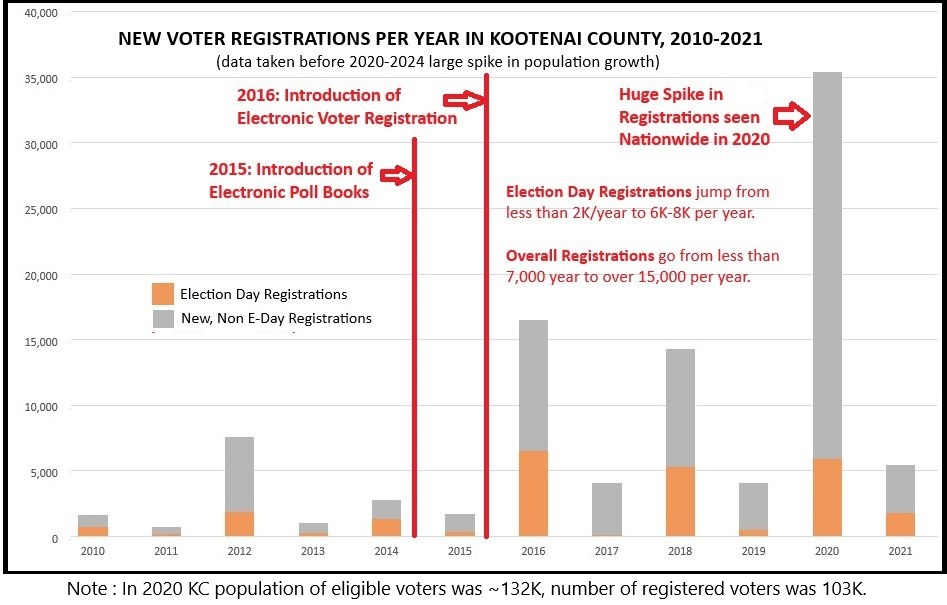
The chart of new registrations by year in Kootenai county shows a dramatic increase in the number of newly registered voters immediately after electronic registration and pollbooks were introduced. This is mainly because electronic registration is not secure, and allows the easy introduction of phantom voters. This has been observed in many states, and the following chart shows that Idaho is not immune.
Computerized election fraud is a national problem, and affects everyone, even in solid red counties like Kootenai.
B.4) Are Kootenai's County Clerk and Election Officials aware of the Problem?
The problems in the recent election have been pointed out and Kootenai election officials have been helpful in providing additional information. However, they are more trusting of electronic election services than they should be. Computerized election fraud is orchestrated by sophisticated computer experts who have access to databases or passwords they should not have, and it is not unusual for people who are not tech-savvy to fail to see the opportunity for abuse.
It appears that everyone in the elections office did their job in terms of tracking ballots, and following current election laws, and were unaware of any problems. That said, there are things that could be done to tighten up security and prevent fraud in future elections, and hopefully some of these improvements will be made.
B.5) Haven't Kootenai's Election machines passed "Logic and Accuracy" Tests?
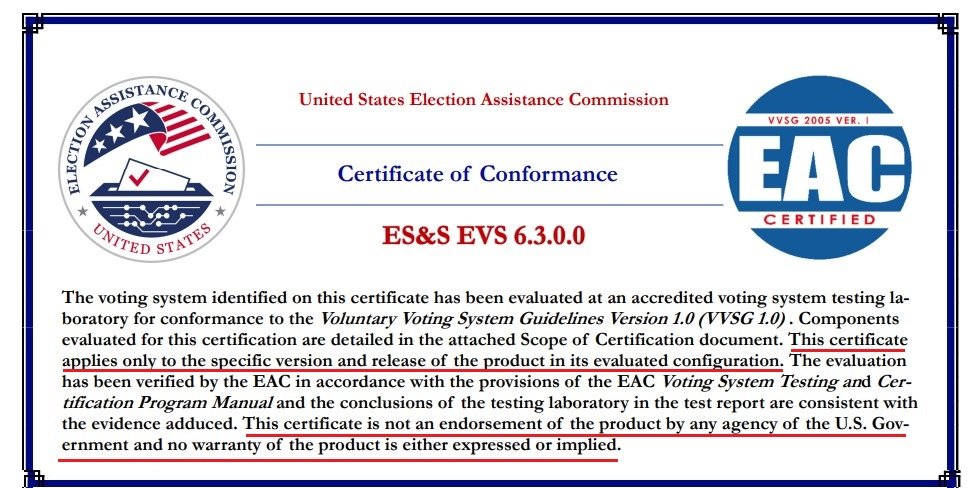
The problem with Logic and Accuracy Tests, and even with offical Federal Certification programs, is that they only verify that election machines are capable of accurately counting ballots. They do not prove that malware cannot or has not been installed that could provide a way for "certified" tabulators to falsify results, when certain "flags" are set. The truth is, even the federal Election Assistance Committee (the government office in charge of certifying voting machines) clearly states that it cannot endorse any products, and it's certificate of conformance is full of disclaimers.
B.6) Wouldn't a recount prove fraud if it had occurred?
Many people believe that machine fraud could easily be detected by a recount, but this is not the case. Idaho statutes governing recounts are very limited and do not give citizens direct access to ballots or allow for independent verification. Recounts allow only 5% of ballots to be recounted by hand,—all others must be retabulated by machine. And state law even designates the specific officials who are authorized to conduct a recount. The article E-fraud: Vulnerabilities-Recounts better explains the limitations of recounts.
Instead of requesting a recount, individuals who were aware of problems in November election provided the BOCC with credible evidence of election fraud several days before the election was certified (see canvassing video at 0:50, 42:30). It was hoped that this would give the proper authorities time to make necessary inquiries. However, the commissioners chose not to investigate, possibly because election fraud is a highly politicized issue.
B.7) How could Kootenai tabulators falsify election results?
Electronic tabulators do two things. First they scan the ballot using an electronic camera. Then they count the votes for various races by running a software program that reads the scanned ballot images. The problem that is inherent in all scanner/tabulators (not just ESS), is that when a scanner is hooked up to a general purpose computer (such as the one used to read ballots and tabulate results), this allows for the manipulation of ballot images. This is important because the question is not, do the tabulated results matched the scanned ballot? Of course they do!!! The tablulations results are always based on ballot images.
The question is, do the official ballot images match the physical ballots? And current election protocols make it almost impossible for an independent observer to answer that question.
Scanning ballots only requires only an electronic camera, whereas tabulating the results requires a computer. These are two completely different functions, and combining them into a single tabulation machine makes the scanning operation invisible to observers, and opens the door to fraud. The good news is, this is not a difficult problem to fix. Kootenai’s current system of tabulation is not transparent or independently verifiable, and the best way to make machine fraud impossible is to greatly increase this is not a difficult problem to fix.
C. Potential Improvements to KC Elections—Q & A
C1. ) How can we restore Integrity to Kootenai Elections? Is hand-counting necessary?
The great benefit of hand-counting is that it relies entirely on physical ballots so there is no possibilty of machine manipulation or the creation of phony ballot images. Many election integrity experts recommend hand counting, and it is common sense that steps should be taken to verify the legitimacy of physical ballot as soon as the precincts close. They less time between polling and counting, the less opportunity for funny-business to occur.
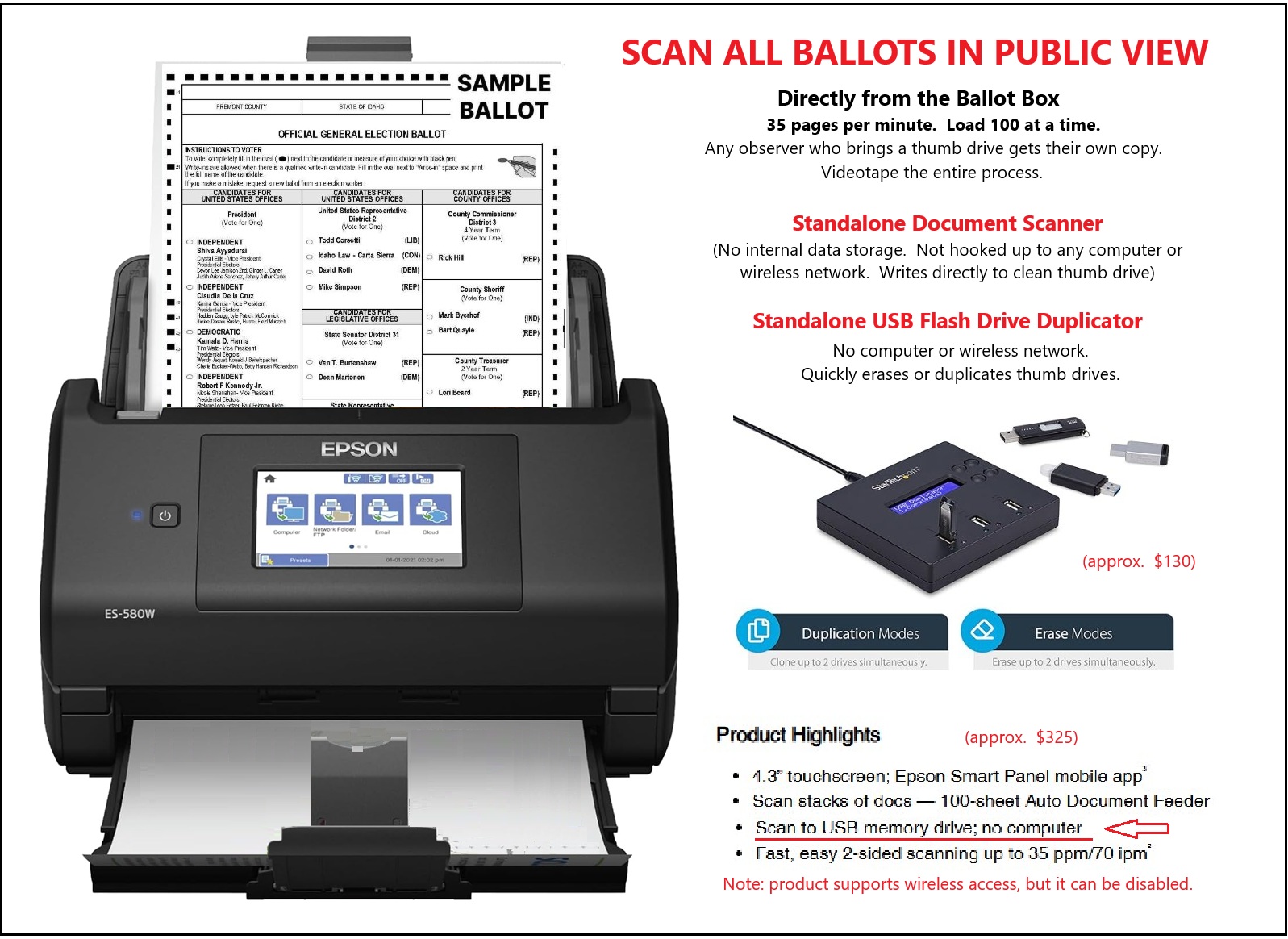
However, because of the perceived difficulties with hand-counting, an intermediate solution has been proposed, that is simpler, and less disruptive to existing election procedures. It involves scanning all ballots in public view immediately after the polls close, on a “stand-alone” document scanner that is not hooked up to a computer and cannot possibly alter ballot images.
Publically scanning all ballots immediately after the polls close would give concerned citizens access to ballot images before they are even tabulated, while still allowing elections officials to run elections using officially certified tabulators as they always have. This process would enormously increase transparency by separating the "scanning" function from the tabulation process, and make machine fraud almost impossible to get away with.
C.2 ) What Can I do to help secure Kootenai County elections?
The best way to help secure Kootenai elections, is to sign up to be a Kootenai poll worker. It is essential that fair-minded patriots who understand election issues, and insist on transparency, are directly involved in our elections, either as official poll workers or as observers. If you register to be a poll worker you will have a chance to attend a training session, which is worthwhile, even if you are not assigned a precinct. And if you help work precincts during elections, either as a paid worker, or an unpaid watcher, you will be contributing directly to you community, and helping to restore trust in KC elections.
NISGR Resources Dealing with Election Fraud
The NISGR slog blog includes numerous articles dealing with election fraud, and is continuing to research the topic.
- The first NISGR article published following the November elections discusses Evidence of Machine Fraud in the NIC Trustee Races.
- A previous article, written after the 2022 election, exposed Glaring Problems with Kootenai Voter Rolls. This is relevant to the current discussion because irregularities in voter rolls enable many forms of fraud.
Of most importance is a three part series that details the vulnerabilities of Kootenai’s election system and provides suggestions for reducing the risk of fraud and increasing transparency:
- Efraud in KC: Part 1—Tabulators: Exposes problems with KC's Tabulators, and discusses the oversized influence that the ESS election technology corporation has over Kootenai's Elections.
- Efraud in KC: Part 2—Vulnerabilities: Details the vulnerabilities associated with computerized elections, and explains how “cheat” software works. Part 2 also explains why Federal “Certification” cannot guarantee secure elections, and why recounts are unlikely to detect machine fraud.
- Efraud in KC: Part 3—Solutions: Proposes realistic solutions for increasing transparency, preventing machine fraud, and making recounts unnecessary by scanning all ballots on a document scanner, before tabulation. This solution is compatible with Kootenai's existing system of central tabulation in the short term, and in the long term allows for other transparent methods of tabulation.
In addition to the articles listed above, The NISGR Rumble Channel includes two videos dealing with Election fraud that could be especially helpful to people who are not familiar with the issues surrounding election fraud.
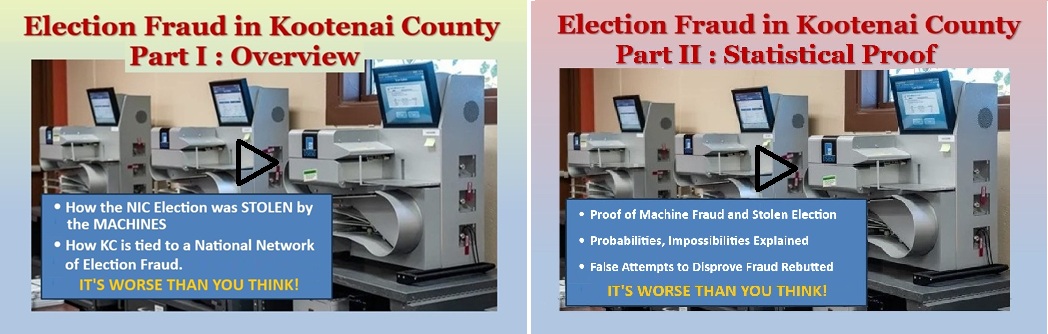
- The video Part 1: Overview of E-Fraud in KC covers the material discussed NISGR's initial article on the topic. But it goes into more detail on topics such as the difficulty of detecting machine fraud is to detect, and how machine fraud is co-ordinated nationally.
- Part 2 focuses on Statistical Proof of Fraud in the NIC Election, and includes a short introduction to statistical probabilities for those not mathematically inclined. It investigates the suspicious difference between early and e-day results, and rebuts some of the explanations people have put forward for it.
A final video worth viewing (but is not on the Rumble channel), is the recording of the November 14th BOCC canvassing meeting at which the Commissioners certified the Nov 6th election. The relevant public comments before and after the meeting are at 0:50, and 42:30.
Comments
- (no comments)