North Idaho Slow Growth
-
Election Fraud in Kootenai—P1: Tabulators
Dec 26, 2024
This is the first of a three-part series on Election Fraud in Kootenai County, and it introduces potential problems with KC's tabulation machines. Part 2 focuses on identifying vulnerabilities in the election system, and the final article suggests ways to increase transparency and prevent machine fraud.
Problems with Kootenai's Election Machines
The potential for rigging election machines in Kootenai County, is worse than most people realize.
Many conservatives are aware that election fraud is a problem nationally, but don't believe that North Idaho is affected. Idaho is solid red and we’ve got trustworthy election officials, so no problem!! Right?
Wrong. Election Fraud is a problem everywhere that globalist stakeholders of any stripe—Democrats, RINO, or FAKE MAGA,—seek to retain their power, and prevent the rise of independent conservatives. And that includes North Idaho, as the recent NIC Trustee Election makes clear.
In recent years, most Election Integrity activists in Idaho have been focused on obvious problems with absentee ballots. But there is a worse threat—machine fraud is more insidious and a greater threat than absentee ballot fraud. This is because when elections are stolen by machine, there is no visible evidence, and no indication of how much fraud was involved.
And it doesn’t mater how honest your election officials are:—machine fraud can happen right under their noses. It is executed by computer algorithms over which local officials have no control, and the network of globalist stakeholders who arrange for computerized rigging of elections have well established methods to cover their tracks.
While absentee fraud is obvious, and is known to have sabotaged many recent elections, machine fraud is nearly undetectable. This is because the images of the ballots generated by the tabulator can be falsified before the data is even read from them, so that the tabulation data perfectly reflects the scanned ballots. And of course, the tabulator images become the official record, while the original ballots are stored under lock and key, nearly impossible to review.
When a good candidate loses a race by obvious absentee fraud, he may believe he has been cheated and try again. But when he loses by invisible machine fraud, he will likely believe he lost fairly and give up the effort. And if this happens year after year, and race after race, good conservatives gradually begin to give up the fight, accept their loses, and resign themselves to permanent minority status.
In this manner, machine fraud can slowly, over time, turn a bright-red MAGA county over to DEM/RINOs without a fight. And this is what is happening right now in Kootenai County.
Deep Dive into KC's Central Tabulators
For this reason, it is time to take a serious look at the central tabulators used by Kootenai County to see what potential for machine fraud exists and what can be done to minimize risk.
This series of articles will not revisit the statistical anomalies that indicate machine fraud in the recent NIC Trustee Election, or speculate on past problems. Instead we will focus on identifying potential problems with Kootenai’s Central tabulators, with an eye towards securing future elections.
When one raises the specter of past election fraud, it risks creating a defensive wall of doubt and denial that complicates forward-looking reforms. Therefore, we will keep our eyes fixed on the future, and will decline to identify any parties that may or may not have been involved in what may or may not have been past election shenanigans.
Our Analysis will cover the following topics, spread over three articles:
- Part 1: Overview of KC’s Central Tabulation System and the problems with corporate control of KC’s Elections.
- Part 2: Risks and Vulnerabilities in KC's Election System.
- Part 3: Practical Solutions for increasing Transparency and Securing KC Elections.
And we will do this without even identifying the election technology company (hereafter referred to as ETC) that Kootenai contracts with for election services, because most of the problems we identify cannot be fixed by changing election equipment suppliers. The difficulties have less to do with the corporation itself, and more to do with the entire, federally controlled process by which KC acquires and operates election equipment.
Who Control’s KC’s Election Tabulation Equipment?
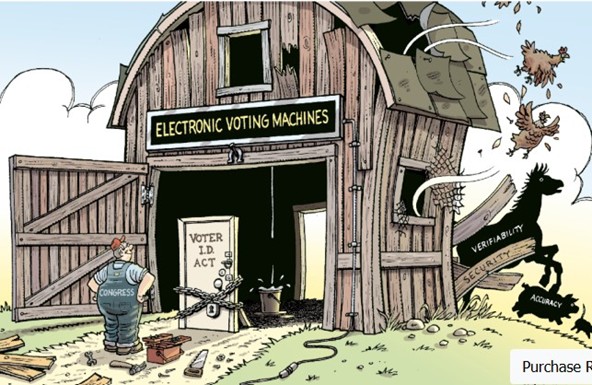
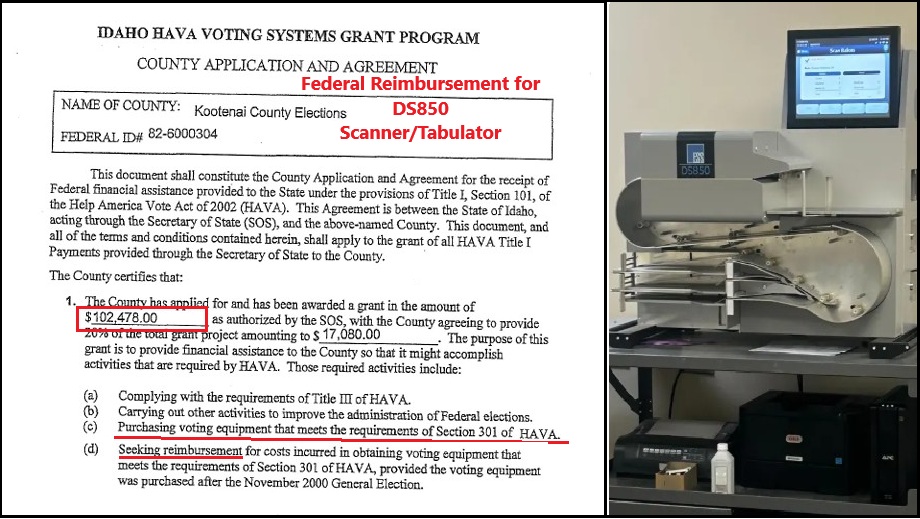
One of the most surprising things that NISGR discovered in its investigations into election fraud is how little control Kootenai County officials have over their tabulation system. It is not, as most people believe, a tool that KC officials decided to use to improve their elections. It is an election system that was designed, put in place, paid for, operated by, and is largely controlled by forces outside of Kootenai county, and even outside of Idaho.
And bear in mind that this system of conducting elections, based on federally funded, certified, and managed central tabulators, has been in place for almost 15 years. Most KC Election Officials are accustomed to relying on ETC machines, and have never known another system.
At one time Kootenai County relied on mechanical voting equipment and results were tabulated in precincts, but Dan English, who was county clerk from 1995 to 2010, was an early adopter of centralized tabulators. In 2008, soon after congress passed the "Help America Vote Act" (HAVA), new tabulators were purchased, paid for with Federal HAVA funds. Then, between 2013 and 2019, these tabulators were also upgraded to newer models, also paid for with federal HAVA grants.
Here are a few things KC residents should know about the equipment that counts their votes:
-
The ETC machines were bought with Federal funds, but KC still pays over $34K per year in maintenance and software license fees. However, KC has no records of specific software updates because they are handled by an outside contractor. So no one in the elections office knows exactly what software is running on the machines at any given time. In terms of election security, knowing exactly what software and firmware is running on your machine is vital.
-
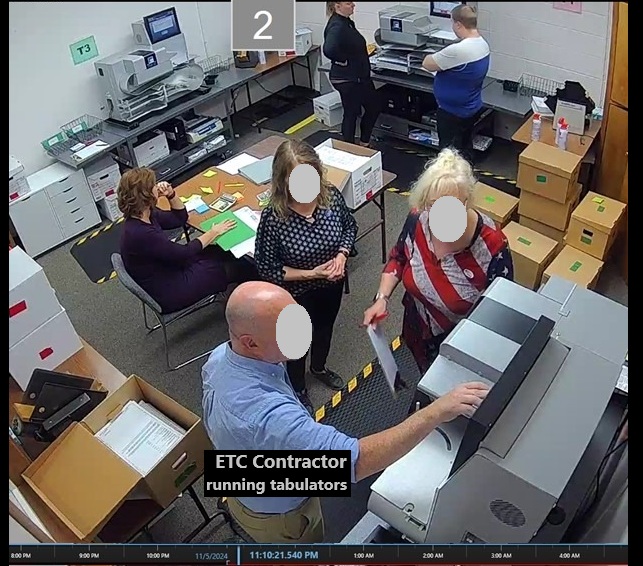
For every election since 2006, a representative from ETC has flown from Omaha for three days before, during, and after the election to provide “Election Support Services.” In other words, Kootenai Employees have never learned to operate or maintain the tabulators well enough to “go it alone”, and have always depended on ETC company “experts” from out of state to be present, on site, during tabulation.
-
ETC not only supplies Tabulators, it also creates the page images for KC ballots. And although it is not the official printer for KC ballots, ETC does have an in-house printing service and provides ballot-on-demand printers.
-
Since KC’s Tabulators are not connected to the internet, the only way to access them is by using ETC’s proprietary thumb drives. Such proprietary devices limit access to the machines for security reasons, but also limits transparency. And KC is not permitted to allow third party inspection of ETC's thumb drives or log files without special permission.
-
ETC’s contract stipulates that 1) all warranties are null and void if KC's system, for any reason, is not the "certified system configuration", 2) that ETC is not responsible for other party's "negligent or willful misconduct", and that 3) ETC is exempt from 42 U.S. Code 1983 and cannot be sued for “deprivation of rights” to a fair election. In other words, if ETC machines or operators interfere with KC residents’ rights to fair elections, then ETC is off the hook, and Kootenai residents have no recourse.
-
ETC is owned by a private equity firm, so there is no public insight into their finances or owners. There does, however, seem to be a connection between the private equity firm that owns ETC and Union Pacific Railroad financial interests (all three are based in Omaha). UPRR has an interesting, and somewhat scandalous financial history with regards to federal politics.
The information above was derived from Kootenai County contracts with and invoices from ETC. Nothing in these documents proves that election fraud has occurred, but they do establish the fact the Kootenai Elections office has very little internal, technical expertise in election machine technology, and relies heavily on ETC contractors and consultants.
To summarize, Kootenai elections are tabulated on machines that were paid for with federal funds, and built by, maintained, and operated by ETC employees and contractors. So for all practical purposes, a privately held election technology company is in almost complete control of Kootenai County’s central tabulators.
And most of Kootenai County’s elected officials are either unaware of the situation or fail to see any problems with it.
What Does KC’s Election Tabulation Equipment Do?
The next thing that needs to be understood is exactly what services these tabulators provide. Because when evaluating the “vulnerabilities” of central tabulators, it is important to understand what they actually do.
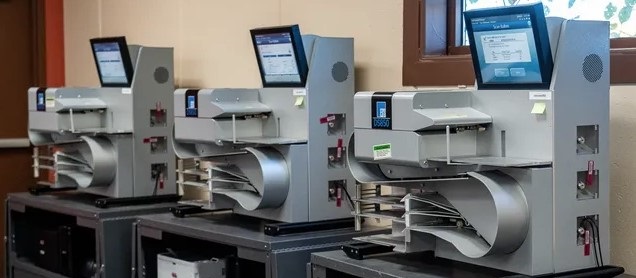
As we have seen from KC’s relationship with its election equipment vendor, discussed above, KC’s Tabulators are treated as a “Block Box”. This means the ballots go in one side, and the tabulation results—along with the “official” scanned ballot images—are downloaded onto ETC thumb drives. And there is no transparency, whatsoever, as to what occurs inside the tabulator.
Central tabulators have two primary functions:
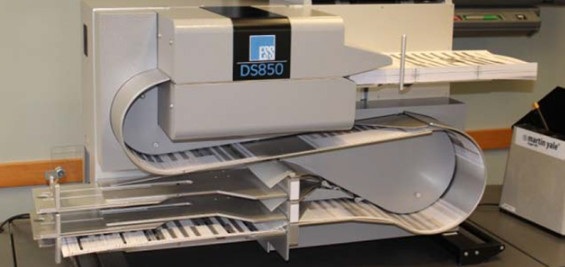
Scanning Ballots—KC’s Tabulator contains a high speed document scanner that can generate digital images of up to 300 double-sided ballots per minute, about 10x faster than a desk-top scanner. The electronic camera portion of the tabulator’s digital scanner uses advanced electronics, but it is a standard component, not much larger than the one in your phone. It is the mechanical difficulties of feeding the central tabulator’s high-speed scanner with hundreds of ballots per minute that makes them large, noisy and expensive.
All the electronics, cameras, and software needed by a tabulator could fit in a laptop. The bulk of the central tabulator is a high-speed paper mover.
Processing Ballot Images—Once digitized ballot images have been created, the software that reads them and tabulates results is very straightforward—or at least it should be. There are three steps.
-
Optical Character Recognition (OCR) —OCR software identifies anything on a digital image that resembles an alpha-numeric character, or any other specialized symbol. In the case of ballots, special symbols include blank and filled in ovals, and specialized barcode markings that can either indicate the location of candidates and races on a ballot, or unique ballot identifiers. Since the Tabulator OCR software is supplied with templates of legal ballots types and only reads ballots, it could be simpler than a general purpose OCR
-
Cast Vote Record (CVR) —The information read from the OCR process is saved in a cast vote record (CVR), corresponding to a pre-defined ballot type. The CVR records the names of every candidate with a filled in oval. Races with no marked ovals are considered “undervotes”. Races with too many marks are considered “over-votes” and flagged for adjudication.
-
Tabulation—Tabulation is the process of counting the information from the individual CVRs for each race and presenting it in readable form.
Combining Scanning and Tabulation
What is clear from this overview is that the scanning of ballots and the processing of ballot images are two independent functions—or at least they should be. There are some advantages to a centralized system of tabulation, but combining scanning and tabulation in a single machine is clearly unnecessary and it provides a mechanism for the tabulation program to influence ballot imaging—which should NEVER be possible.
It seems that from a transparency and election integrity point of view, one would want to separate these tasks. Why did anyone ever think that having the same machine generate ballot images and tabulate ballot images was a good idea? This is a recipe for systematic election fraud.
We will discuss problems with central tabulators in a later article. Here we just want to point out benefits of decentralized scanning.
The most technically challenging and expensive part of the design of a centralized tabulator is its high-speed ballot processing capability. And the problem is not only mechanical—even the software has to deal with problems such as jammed ballots, and other complex operational errors. But if ballots were scanned at the precincts on normal, 35 ppm document scanners, there would be no need for cumbersome, hard-to-maintain, high speed scanners.
And commercial document scanners that are not hooked up to any computer, would have no capability whatsoever of modifying ballot images. Decentralized scanning would be both faster and more transparent than centralized scanning as long as basic security measures were in place.
And best of all, scanned images of ballots could be uploaded and made publicly available immediately, before the ballots were even tabulated. And long term, having independently scanned ballots, would open up the possibility of using services other than ETC for tabulation. Because truthfully, once ballot images have been created, the tabulation of such images is straight forward, and is not an enormously challenging software problem.
It is interesting that in ETC's contract, it is stipulated that KC must protect the "confidential and proprietary trade secrets" of ETC software. Because when you think about it, the whole idea that tabulation software should contain “trade secrets” is somewhat disturbing.
Continue reading part 2 . . . .Risks and Vulnerabilities
Comments
- (no comments)