North Idaho Slow Growth
-
Mass Data Collection Disguised as Election Integrity
Mar 10, 2025
House Bill 339—Regarding Elections: "Repeals and adds to existing law to establish provisions regarding the accuracy of voter registration information."
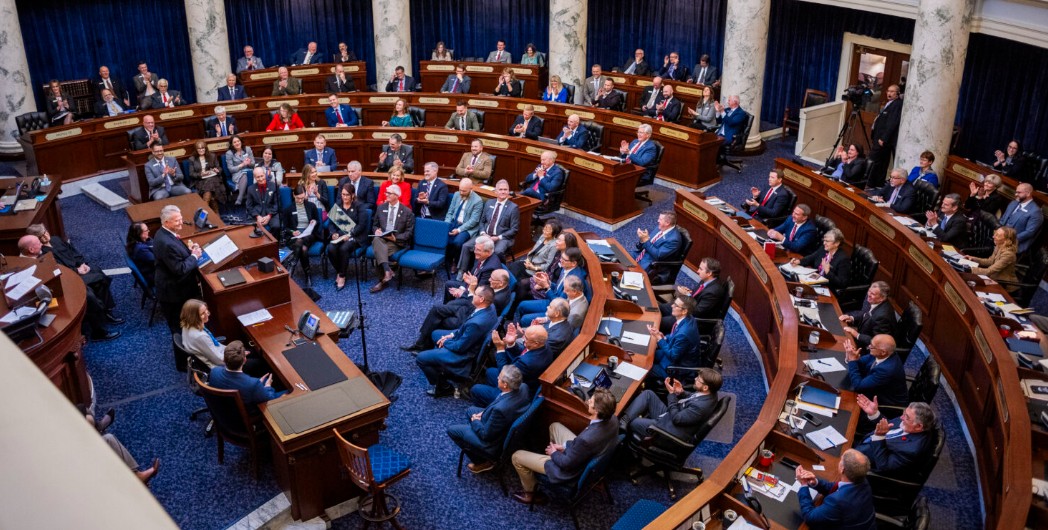
Last in the 2025 legislation session, at the behest of the Secretary of State, House Bill 339 was introduced to that State Affairs Committee. The SOS, who spoke in favor of the bill, said that it would give him the necessary tools to verify Idaho's voter rolls, by allowing his office to collect and process data about Idaho voters from many sources, including Federal, State, local, government agencies and even private entities. He also claimed that this bill did not give the SOS any new powers, and did not violate any voter's rights to privacy. Instead it just codified his rights to access data that was already available to him.
Unsuprisingly most legislators took the bait. Who wants to be on record as opposing election integrity? The Secretary of State's office has the responsibility of verifying voter rolls, and if he thinks he needs to collect data about Idaho voters to do this, who is wants to stand in the way of these necessary measures.
Unfortunately, it is likely that many of the legislators who voted for this this bill did not fully understand it, or were misled by the answers provided by the Secretary of state, or were not familiar enough with how the SOS office uses private corporations to verify data, to clearly see the potential for abuse.
In truth, HB 339 is a poorly conceived of bill that completely fails to verify voter rolls, and gives the Secretary of State unprecedented powers to collect data from dozens of sources about Idaho voters. Furthermore it explicitly allows the SOS to pass this data on to unnamed private agencies, at least one of which, almost certainly AAMVA, the NGO that is leading the effort to digitize Idaho Driver's licenses. And coincidentially, the data the SOS is requesting is the exact data that AAMVA needs access to in order to create ditigal Identification.
HB 339 is a disastrous bill, that needs to be repealed and the whole subject of how best to secure Idaho voter rolls needs to be revisited.
Letter to Senate State Affairs Considering House Bill 339
NISGR spoke against HB 339 when it was being considered by the Senate State Affairs Committee. Afterward and minor changes were made, but they did not address the main problems with the bill, and the modified bill was passed without further debate just days before the end of the session. The text of the letter submitted to the State Affairs Committee is as follows (illustrations were not included in the original text):
Greetings Senators,
I am writing in opposition to House Bill 399 regarding elections. I am a retired Electrical Engineer with a good understanding of software, data analysis, and electronic security issues. I am opposed to the bill for three reasons:
1) Overbroad, open-ended, and invasive data collection
HB 339 authorizes the SOS to collect, store, and process much more data than is needed to verify voter eligibility and registration data. Sections 1 (a), and (b, i-iv) provide for very broad and open-ended requests for data, from dozens of government agencies. But of most concern is 1.b (v)
“At any time, at the discretion of SOS, request from any entity, including cities, counties, state entities, and third-party data providers, any information that would assist in ensuring the integrity of Idaho’s voter registration information, . . . .. Entities located in or subject to the jurisdiction of Idaho . . . . shall comply within 30 days . . .”
This is overly broad and could lend itself to abuse. Granting the SOS access to the personal information of Idaho residents maintained by local governments and private corporations is a dangerous, invasive path to go down, and cannot possibly be necessary to verify eligibility.
There is a big difference between making targeted requests for specific data, and making overly broad, recurring, blanket requests for personal data on hundreds of thousands of Idaho voters.
2) How will the data SOS collects be used, retained, and shared?
My second reason for opposing HB 339 has to do with how the data collected and stored by the SOS will be used, how it will be retained, and what agencies it will be shared with.
In HB 339 Section (2) it is stated that “The SOS is authorized to contract with commercial data providers including, but not limited to credit agencies, …to assist the SOS in verifying and auditing information in voter registration lists, including, but not limited to, citizenship status and residence. This phrasing is very open-ended, and provides enormous leeway to the SOS, regarding how voter personal information is used, and who has access to it.
The “Legislative Intent” states that the only allowable purpose for the collection of this data is to verify data rolls. But if this is the case, the personal data collected by the SOS should not be retained after a voter record is verified, or used for any other purposes, and section 2 should include explicit LIMITS what can be done with the data, and how long it can be retained, and who can have access to it.
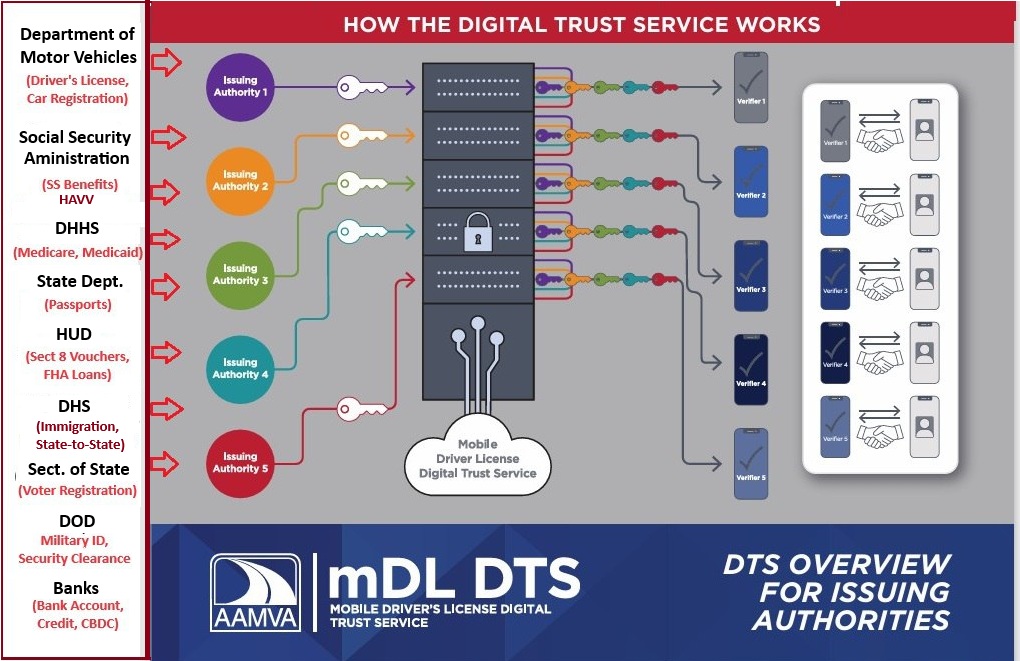
One of my concerns regarding usage of the data SOS collects, has to do AAMVA (the American Association of Motor Vehicle Administrators), a private corporation, that is aggressively promoting Electronic Drivers licenses. The AAMVA has long been a contractor with Idaho’s SOS to do Data verification checks, and it has not escaped our notice that House Bill 78, a bill currently before the Senate Transporation Committee, would allow ITD to introduce electronic Drivers Licenses.
It seems somewhat suspicious therefore, that HB 339 directs the SOS to collect so much more data, from many more agencies, than is necessary to verify voter rolls. And the data it appears to be collecting is almost exactly the data that AAMVA would need to implement its mobile Driver's License and “Digital Trust Services .
So my question for the Secretary of State is, does he intend to give AAMVA access to all of the personal data that he will collect on all Idaho voters in order to facilitate a transition to fully functional electronic drivers licenses. If this, in fact, is being planned, it should be explicitly acknowledged. And HB 339 data collection should not be used to provide a “back door” implementation of Digital IDs, without the knowledge of Idaho residents.
3) The HB 339 Plan for Voter List Verification leaves HUGE loopholes for FRAUD
My final objection to HB 339, is that that I believe the approach it takes to voter roll verification is deeply flawed, and that HB 94, which focuses on the task of verifying U.S. citizenship is a simpler and more effective way to verify voter eligibility. The main problems with HB 339’s approach to voter verification are as follows:
- Eligibility should be verified ASAP after registration—HB 339 provides for processing recent registrations at one time, 90 days before an election. But this allows for a three-month window in which sophisticated fraudsters can continue to create fraudulent registrations. It makes no sense to delay verification. The SOS should set up a system of verification that can be done almost immediately after registration.
- Ban Electronic Registration—Most fraudulent registrations are accomplished by computers who have access to the DL#s and SSN# and other personal data of real Idaho residents. They are fraudulent, not because their “data” is inaccurate, but because they were registered without their knowledge by bad actors. This type of registration fraud will not be detected by the SOS voter verification checks, because real resident data might be used. But it could largely be prevented by eliminating electronic registration. It is computerized fraud using online registration that is polluting our voter rolls, so banning electronic registration should be the first step anyone takes to clean up voter rolls.
- Do not Over-complicate Verification—It is unfathomable why HB 339’s uses so many different sources to verify registration data. Attempting to compare that many records from many different agencies, is not only invasive, it is bound to turn up problems, and inconsistencies. But not all conflicting information indicates voter registration fraud. Many people use different variations of their names or have multiple or part-time residences. What set of rules does the SOS propose to use to resolve such ambiguities? Using so much data to compare with voter registration is massive overkill, and will almost certainly result in many false "inconsistencies" that have no bearing on voter eligibility.
Thank you for your time and consideration.
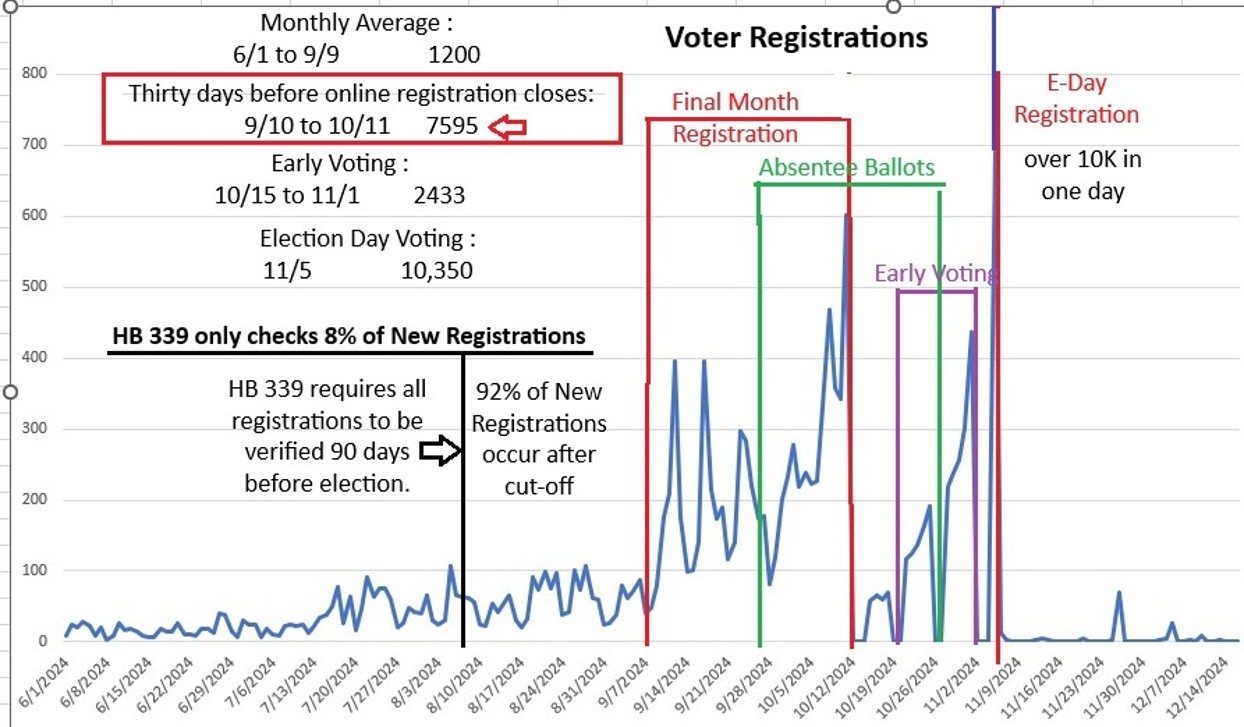
The blue line in this diagram shows voter registrations over time in Kootnai County, and it clearly shows that over 90% of all new registrations occur withn 90 days of an election. By doing the voter verification checks 90 days before the election, almost all new registrations are not verified until they have already been permitted to vote.
Then, even if a voter is disqualified they can re-register for the next election, and vote again.
Comments
- (no comments)