North Idaho Slow Growth
-
Digital Identities—Who Verifies the Verifiers?
Feb 1, 2025
Digital Identities—Who Benefits?
The citizens of Idaho do not want digital ID. The push for electronic DL is coming from a corporation that benefits from digital verification services, both financially and politically.
American Association of Motor Vehicle Administrators (AAMVA) has been granted a monopoly on the business of verifying the personal identities of Americans based on government records, and it is the organization that is promoting and seeks to control digital licensing.
Yet the AAMVA is a PRIVATE CORPORATION that is not accountable to the public and is not subject to Public Records Requests.
The AAMVA already has tremendous influence and a privileged relationship with dozens of government agencies (including ITD and Idaho’s SOS). And it is the organization that is masterminding the consolidation of enormous amounts of personal information into a “universal” digital ID, necessary to access any and all government services.
Why does a PRIVATE CORPORATION HAVE THIS MUCH POWER? And why is Idaho considering granting this unaccountable corporation control over identity verification of Idaho citizens?
What is the AAMVA?
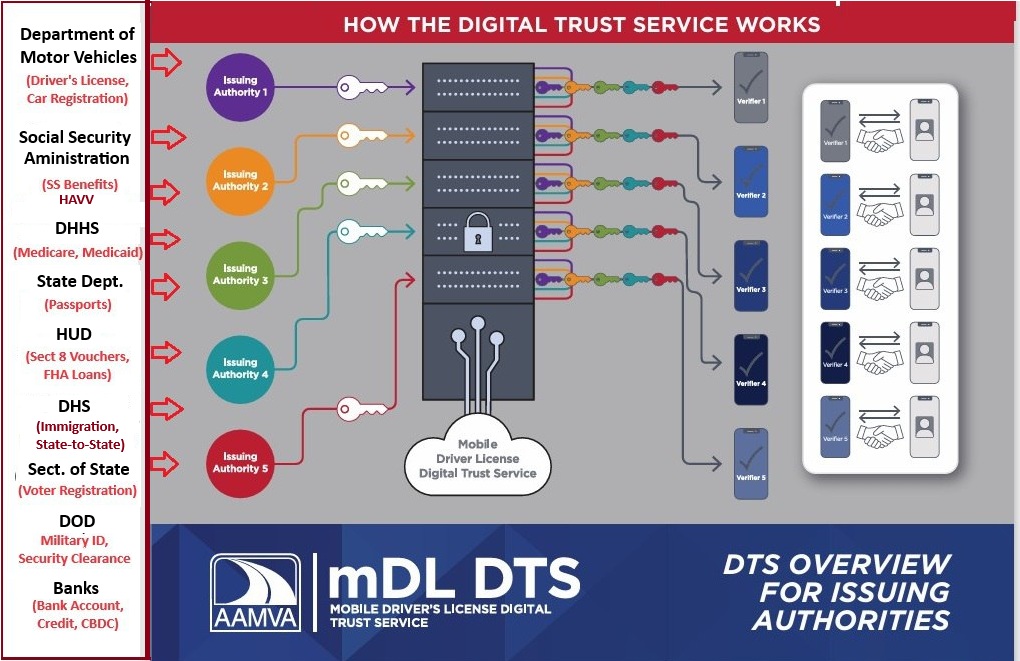
The corporation that has been granted a monopoly on the business of verifying the personal identities of Americans based on official government records is a privately controlled, and very secretive non-profit corporation, that appears to have its hands in everything related to identity verification,—from commercial licensing, to voter registration, to passports, to social security, and more.
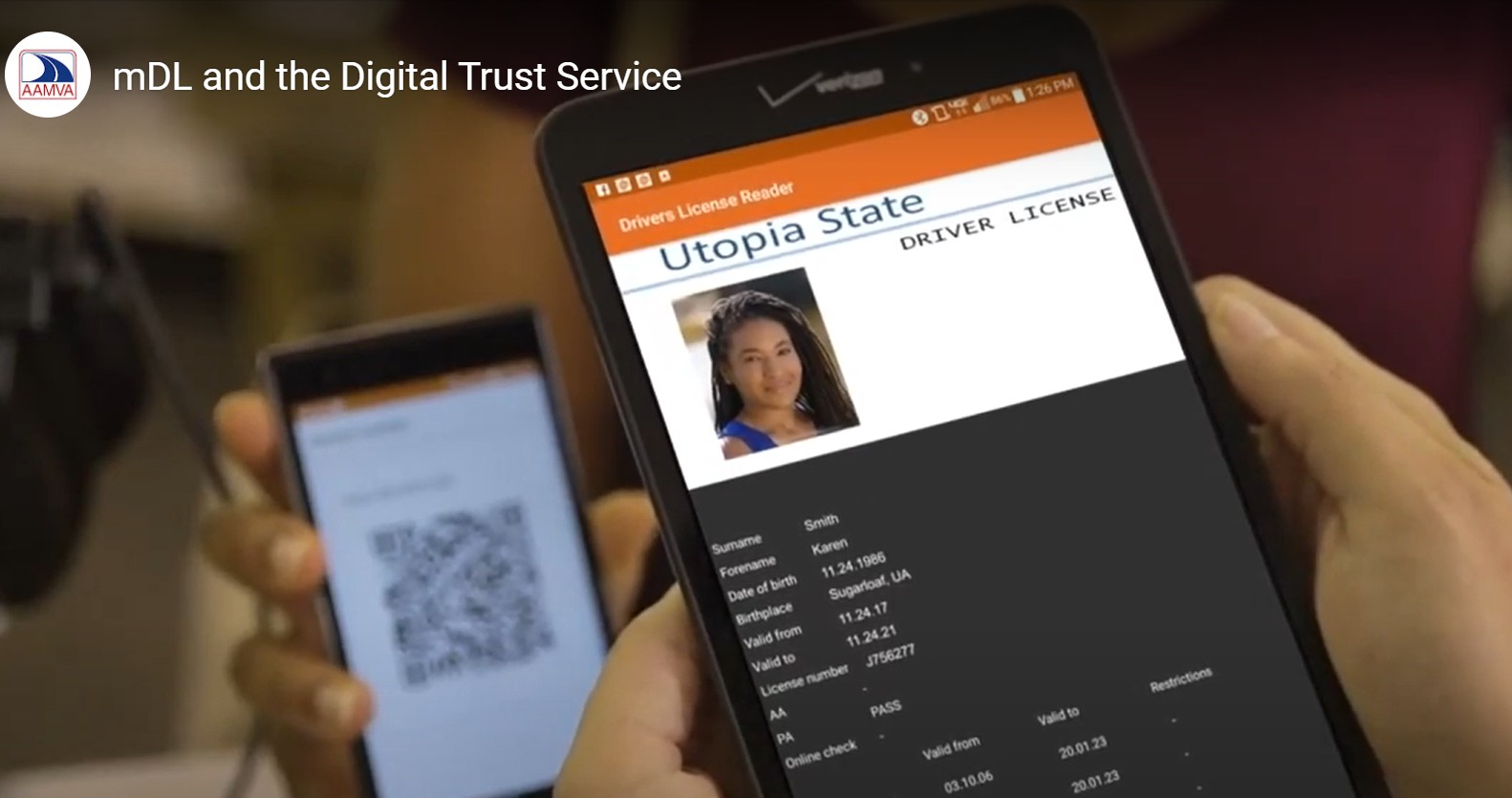
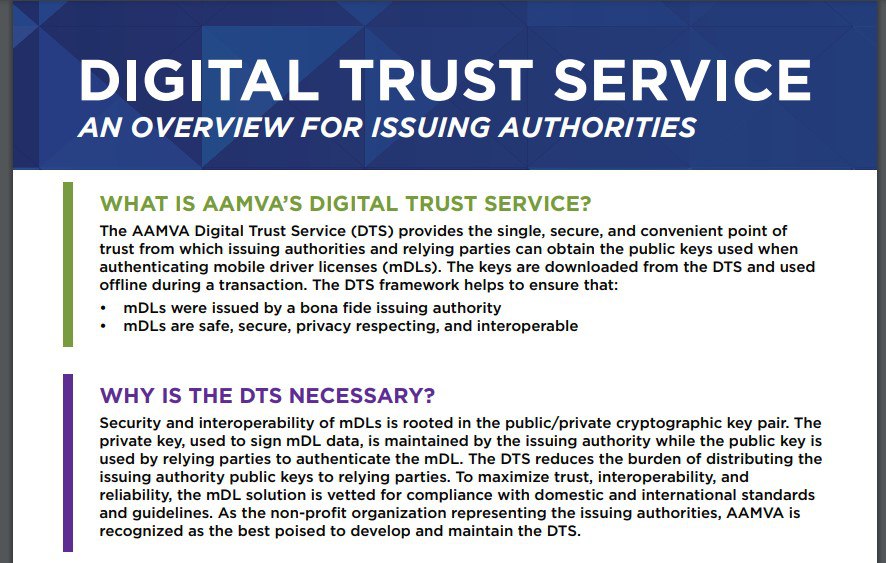
This private corporation is the American Association of Motor Vehicle Administrators (AAMVA), and it has big plans for consolidating enormous amounts of your personal information into a “universal” digital identification pass of the future. (see the "utopia state" video describing mDL-DTS here.)
Few people know anything about AAMVA. It is a small agency employing only a few hundred people. Yet it has revenues of over 50 million dollars annually, mostly from providing identity verification services to government agencies and corporations.
And yet one of the most alarming things about AAMVA is that it is so small. Amost all of its employees are involved in promoting Digital ID and providing verification services, so it CANNOT POSSIBLY have either the technical expertise or resources in-house to develop and maintain the sophisticated verification tools that it offers to states to secure digital IDs.
This means that the software that controls and verifies e-licenses must be developed by outside, unknown contractors, which is a HUGE security issue. It almost seems that the AAMVA is operating as an intermediary between state agencies, and dubious, unknown forces that are behind the move to manipulatable, controllable, digital identification.
Who are these unknown, outside forces? We don’t know, but one clue is that the “American” in its name refers to North America (not the USA), so AAMVA membership is open to Canadian and Mexican officials. And AAMVA’s futuristic vision of universal digital identity keys aligns with a globalist vision of a borderless, technology-dominated, super-state.
The membership of AAMVA is limited to government officials and most of its employess are former government officials. And through its working committees, AAMVA develops standards, “best practices” and guidelines for identity verification, motor vehicles, driver credentialization, law enforcement, highway funding, and data privacy.
The AAMVA does much of the work that you might expect a federal agency to do, yet all of its meetings and internal documents are exempt from public records requests, and none of its goals or policies are subject to government oversight.
So who is REALLY behind AAMVA?
A Private Conduit for Public Records
The AAMVA makes an enormous amount of money—over $50M in 2022—by offering access to government databases. For example, the AAMVA’s Driver License Data Verification system allows corporations and financial institutions to verify that a state-issued drivers’ license that has been presented to them is authentic. It can do this is because the AAMVA is allowed to query all 50 state DMV databases, and has been given a monopoly on this type of access.
Its obvious that AAMVA plays privileged role in providing public access to DMV records from all fifty states, but that is just for starters. AAMVA has also been given privileged access to data from the Social Security System, and in many ways, this is even more disturbing.
The “Help America Vote Act” of 2002 stipulates that during the process of voter registration, State DMVs must be allowed to query the Social Security Administration in order to verify the last four digits of a social security number for potential voters who DON’T have picture ID. And in order to comply, the Social Security Commissioners decided that AAMVA should act as an intermediary for this purpose.
The AAMVA also acts as an intermediary for verifying SSNs for governments and non-profits who are acting on behalf of clients who are requesting social security benefits.
And think about how much power is entrusted to AAMVA to approve or decline identity verification!
AAMVA is the agency that informs the Secretary of States whether or not someone who provides a name, birth date, and social security number can register to vote. A false negative denies a working American, who for some reason has no other state issued ID—their right to vote. But a false positive enables voter fraud.
Likewise with the role the AAMVA plays in verifying persons who qualify for Social security benefits. A false positive enables systematic social security fraud, which we know know has occurred on a rampant basis.
So AAMVA is the gate-keeper of important government information, and the guardian of legitimate licensing, and it has access to a complete database of all DMV and social security numbers, so it must be honest, right? How do we verify the verifyer?
WE CANNOT. AAMVA is a privately controlled corporation, not subject to FOIA.
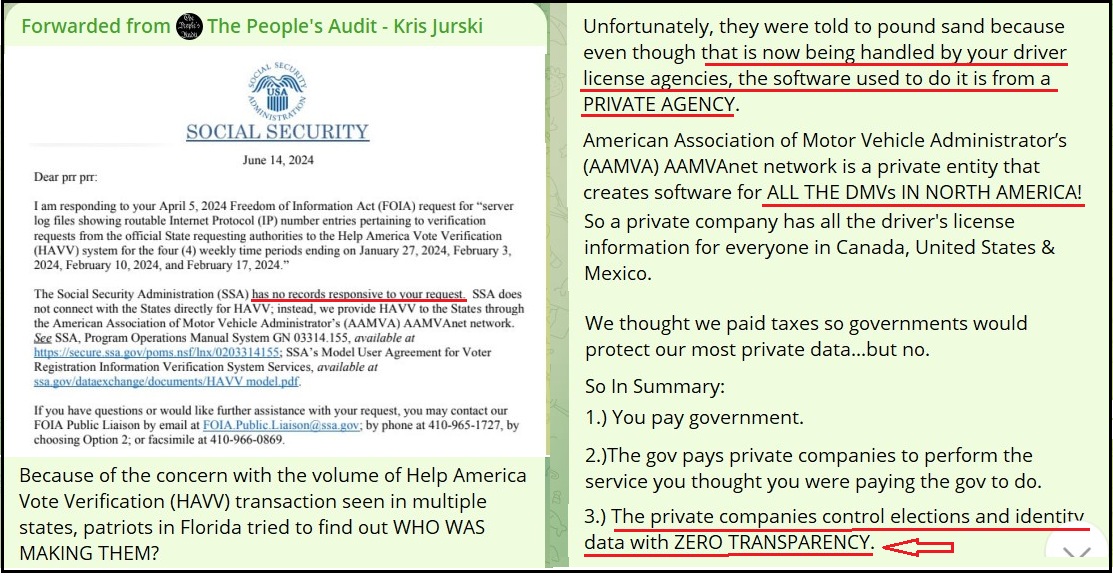
So what happens when someone requests data, regarding a large number of suspicious requests for social security verification for voter registration. Kris Jurski of The People’s Audit did just that, and this was the response.
As Jurski points out, the HAVV requests for social security verification were made from one government agency to another. Yet they were intentionally routed through AAMVA—a Private Party,—to avoid public records requests. So Jurski was told "no such records exist."
This does not inspire confidence either in AAMVA, or in the government agencies that use it as a conduit to avoid accountability. And there is no recourse. The AAMVA is the agency that is responsible for verifying identities and credentials that depend on Social Security and DMV records, and it is exempt from FOIA or independent audits.
No wonder voter fraud and social security fraud have run amok. The agency tasked with verifying our identities, and providing “Digital Trust Services” cannot be trusted, and cannot be audited.
An Information Clearinghouse
And so far, we have only talked about the problems with AAMVAs involvement with verifying Social Security and Voter registration eligibility. But there is much more.
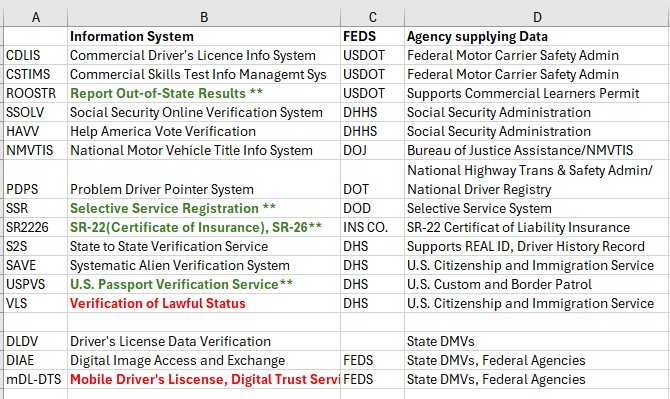
AAMVA is the intermediate organization for handing data requests from numerous Federal agencies, including the Departments of Transportation, Selective Service, Health and Human Services, Justice, and Homeland security. It also tracks certificates of insurance issued by private Insurance companies, and complete driver histories so that “problem drivers” cannot escape from a bad driving history by moving out of state.
The following chart, is derived from information on the AAMVA website, describing their verification services. and it illustrates some of the ways that AAMVA serves as a private conduit for government data transfers, and for consolidation of personal information into a centralized database.
We cannot go into detail over all of the services that AAMVA provides, but their reach is very wide. And any time AAMVA is tasked with accessing data from a government server, that transaction becomes invisible, because it is being transacted by a private, rather than a public entity.
But things begin to appear even more sinister, when one looks at AAMVA’s vision for its mobile Drivers License and Digital Trust Service. It’s goal of “one driver, one license, one record” means that a single agency--AAMVA--controls access to everything. Such a “universal” driver’s license is a fundamental building block of SMART cities, around the clock surveillance, and technical tyranny.
It is true that drivers licenses are used by many different agencies to verify identity, and there is some value in having a way for institutions to verify the authenticity of D.L. by a simple query of state records.
But there is no reason an Identity card should be digital, or that it should store any data beyond one's name, address, and photo-ID. And a private, unaccountable agency should certainly not have any role at all in formulating policy, or providing “Digital Trust Services” for an intrusive, and over-reaching universal ID.
Electronic Drivers Licenses are certainly not a direction that Idaho citizens want to go, and the best policy for legislators is to reject the move towards digital identities, and to avoid, as far as possible, any dependence on AAMVA services.
AAMVA’s vision of a digital “mobile” drivers license, and a single, universal identity record is deeply flawed, and Idaho voters do not want to go down this path.
Comments
- (no comments)