North Idaho Slow Growth
-
This is an open letter to Idaho Legislators, asking them to rescind or revise a bill passed in the 2025 session that authorizes open-ended collection of the personal data of Idaho voters. HB 339 was presented as an "election integrity" bill, but it is deeply flawed and does far more harm than good.
Data Collection Disguised as Election Integrity
The most harmful bill passed in the 2025 legislative session was House Bill 339, a bill that authorized open-ended data collection on every Idaho voter under the guise of “election integrity.” Because the bill was introduced as a way to verify citizenship and validate voter rolls, many legislators failed to recognize its problems—namely:
- HB 339 authorizes the SOS to collect unlimited personal information about Idaho voters from dozens of sources, including much more data that can possibly be needed to verify voter registration data.
- HB 339 authorizes the sharing of voter's personal data with unspecified public and private entities and does not place limits on how the data will be used.
- The method by which Idaho’s voter rolls are verified, using data collected by the SOS, has numerous loopholes that allow for continued fraudulent registrations.
HB 339 gives the Secretary of State enormous, open-ended authority to collect and process the personal data of Idaho residents, and there is reason to believe that the consolidation of so much personal data on a single platform may be a stepping stone to digital ID.
We believe that House Bill 339 (now codified as ID 34-433) is so invasive and open to abuse that rescinding or amending the affected statutes should be a top priority of the 2026 Idaho legislature. But before considering specific changes, it is important to understand why the bill was proposed, and why it is no longer necessary or helpful.
Little's Executive Order and House Bill 339
The unprecedented influx of illegal aliens during the Biden administration caused enormous problems for state governments. Many non-citizens were given government benefits, assigned social security numbers, and even enrolled as voters; and due to problems at the federal level, it was difficult for states to determine their legal status.
In response, in 2024, Governor Little signed “executive order 2024-08 the "Only Citizens will Vote Act", requiring the Secretary of State to “take all necessary steps to . . . validate voter registration and prevent non-citizens from registering to vote.”
House Bill 339 was drafted in response to the Governor’s executive order, but instead of focusing on the problem of non-citizens voting, legislation was proposed that took an extremely broad approach to “validating voter registration.” It gave the Secretary of State open-ended authority to collect data related to Idaho voters from dozens of public and private sources that far exceeded that which was necessary for voter roll verification. [34-433 (1)(b)(i-v)]
And to make matters worse, the overly broad approach HB 339 took to verification of voter rolls [34-433 (3)(a-c)] left many loopholes for fraud. A more narrowly crafted process that verified citizenship at the time of registration and collected only necessary data, would have been far more effective.
And it is precisely the fact that the bill's main focus seems to be on mass data collection rather than efficient voter roll verification, that make it appear that HB 339 was intended to be a backdoor data aggregator for Digital ID.
Preventing Non-citizens from Voting
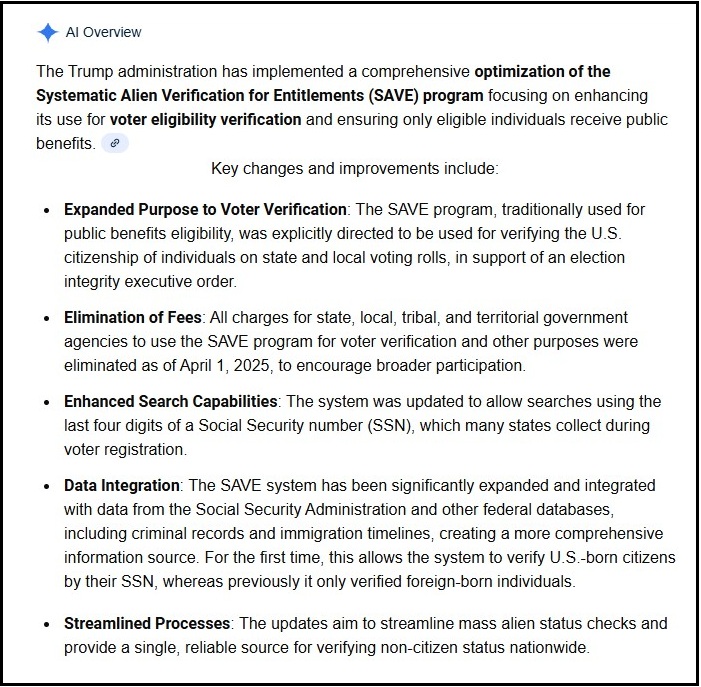
The problems with federal management of illegal aliens that inspired Governor Little’s "Only Citizens will Vote Act" affected all states and were an obstacle to Trump's plans for immigration reform. So as soon as Trump returned to power, USCIS made significant reforms to the to the SAVE (Systematic Alien Verification) program, and directed all states to use the improved system for verifying voter registration.
There is now a straightforward way for all states to verify voter citizenship, and the SAVE program can be accessed at the time of registration, rather than months afterward. These reforms solved one of the main problems that HB 339 was intended to address, and makes much of its data collection unnecessary. A summary of Trump's reforms to the SAVE program is shown here:
A Flawed Approach to Voter Roll Verification
We can see that HB 339 is no longer required for the SOS to verify citizenship of registered voters. But the bill was also intended to validate existing voter rolls and root out fraudulent registrations. It does this by collecting enormous amounts of voter data from many sources, and then searching the data for inconsistencies. But this is not an effective approach to voter roll verification, for a number of reasons.
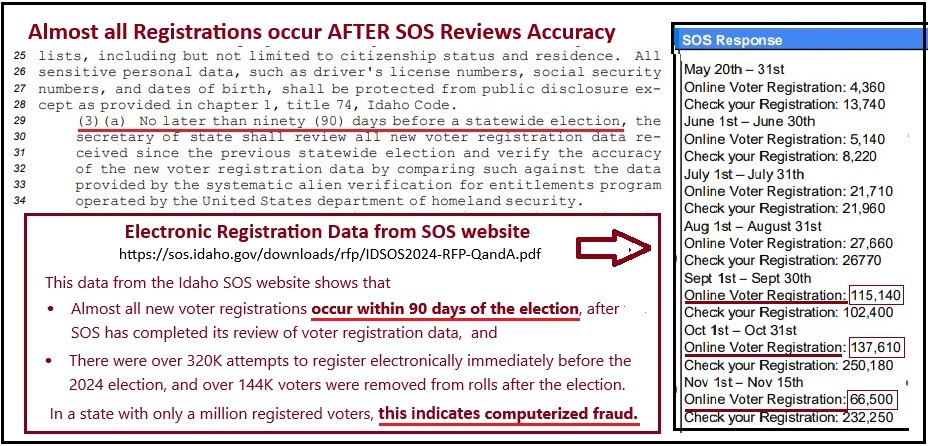
1) Verification Must Occur at the time of Registration—[34-433 (3) (a)] requires that all voter registrations be reviewed twice a year, 90 days before each election. But since almost all new voters register within this 90 day window, virtually all will be approved and allowed to vote before their eligibility is verified. The obvious solution would be to verify the eligibility of applicants at the time of registration, rather than months later.
The chart below from the SOS website proves not only that the vast majority of voter registrations occur during the 90 day window prior to elections, but also that the number of electronic registrants statewide is suspiciously high and appears to be computer generated rather than organic. The article Data Collection Disguised as Election Integrity discusses problems with HB 339 verification, and shows that it is virtually impossible to clean up voter rolls as long as online, electronic registration is permitted.
2) Computer generated, “Phantom” Registrations are Undetectable—HB 339 treats voter roll fraud as if the root of the problem is individual, human fraudsters who use counterfeit ID, or fraudulent addresses to register to vote in multiple locations. But the real cause of fraudulent voter rolls is sophisticated, computerized fraud, whereby software programs with illicit access to the personal data of thousands of Idaho residents, create “phantom” registrations, using real voter data. And once these automated “phantom” registrations are accepted, they are indistinguishable from real voter registrations.
Dr. Douglas Frank's three minute video, Proof that Every State’s voter rolls are centrally controlled, provides undeniable evidence that most fraudulent registrations are generated by computer algorithms rather than by individuals, and the article Digital Identities and Phantom Voters discusses why phantom registrations are nearly impossible to detect.
3) The amount of data HB 339 collects far exceeds that necessary for verifying voter rolls—Comparing dozens of voter records, may very well flag inconsistencies, but not all inconsistencies in personal records are indicative of voter fraud. Many people use more than one name, or more than one address for various purposes, and there is nothing illegal about this, as long as they are only registered to vote in one location.
There is a legitimate need to make sure people are not registered in multiple locations, and to identify deceased and incarcerated voters. But the data needed to adequately verify registration data is confined to just a few offices (DMVs, SSA, NCOA and other state agencies), that the secretary of state is already authorized to access. So no new authority to collect data is required to verify voter registration rolls, and HB 339's approach of flagging inconsistencies in the personal data of dozens of unrelated records, complicates the verification process for no good purpose.
Who Has Access to the Data Collected?
Possibly the most disturbing aspect of the HB 339 is that it gives the SOS open-ended authority to share the data collected with unnamed public agencies, and private corporations (. . . "The SOS is authorized to contract with commercial data providers, including but not limited to credit agencies and commercial data providers, to assist the secretary of state’s efforts in verifying and auditing information in voter registration lists, including but not limited to citizenship status and residence . . . etc. " )
The code does assure us that "sensitive personal data . . shall be protected from public disclosure", but who knows what is meant by that? We don't know who has access to the data or what they are doing with it? We don't even know what the SOS means by "verifying and auditing information in voter registration lists". We are not told how the data collected will be used or by whom.
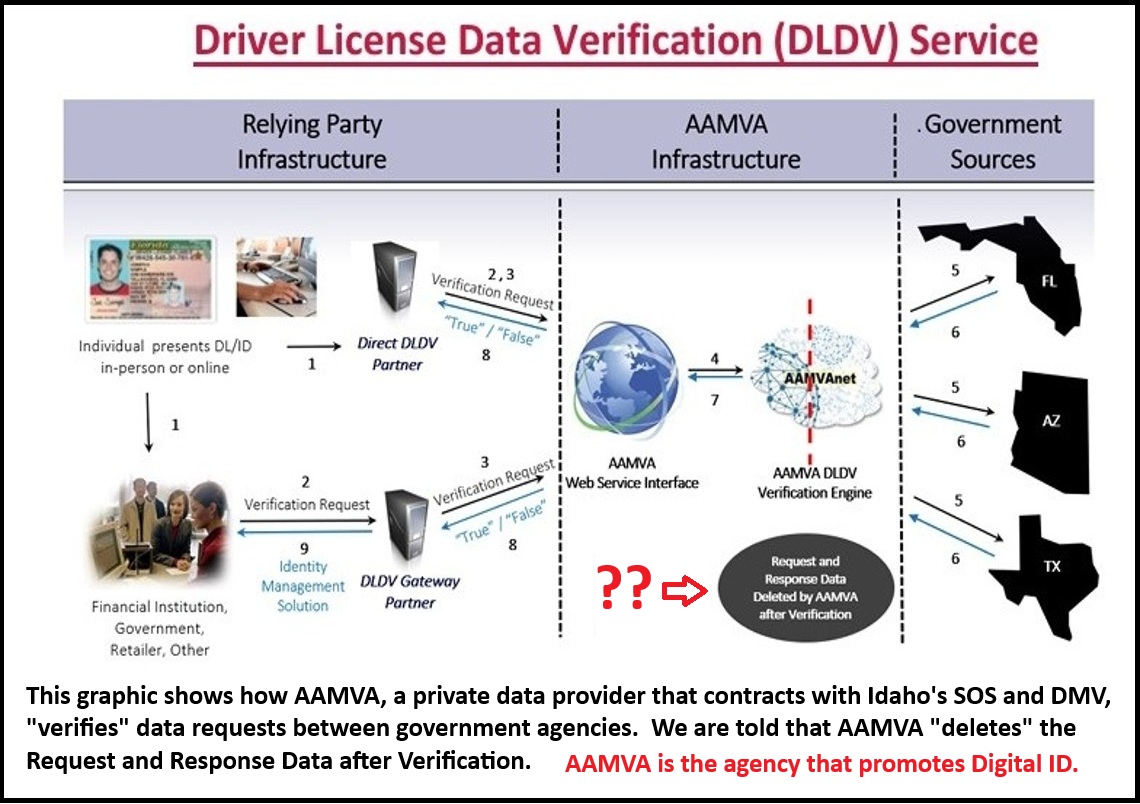
There are no explicit restrictions anywhere in the statute on how the data will be used, but for some reason, in section 34-433 (5) the SOS is required to store the data "in a secured cloud system", rather that on a dedicated system in the SOS's office. Why the personal data of Idaho voters should be processed in "cloud storage" is not explained, but one reason it could be is that AAMVA, a private non-profit that promotes and facilitates Digital ID operates on Amazon's cloud-based "web services".
AAMVA already provides data services to Idaho's DMV and SOS office, and it was named as the service provider in House Bill 78, a bill allowing for Idaho to provide Digital Driver's Licences, which passed the House (but not the senate) last year.
So if the SOS collects unlimited personal data concerning all Idaho voters on a routine basis, from dozens of public and private and then updates that data to the "a secured cloud storage" system, and then makes a "contract" with AAMVA to help "verify and audit" that data, what we have is the entire "backend" of a Digital Identification system being set up by stealth, under cover of "Election Integrity".
This is an unacceptable violation of the privacy of Idaho voters, and the statutes currently in place need to be changed to prevent this type of abuse.
The use of data collected by the SOS to serve as the backend of a Digital ID system is the "worst case" scenario, But what we know with certainty is that the personal data of Idaho voters collected by the SOS will be accessible to the Tenex "Voter Central" software that is part of Idaho’s already much-to-centralized Election Management system. Features that integrates data from many other "agencies and information soures" is already built into the existing system. This means that the Tenex "Election management" software has access, not only to the name, address, and voting records of all Idaho voters, but to a great deal of their personal data.
The risks of centralizing control of all election data into a single software package are discussed in the article Digital Elections, Digital Identities. But in short, centralization of election data facilitates computerized fraud, and the there are many questions about what entities created and have access to the Tenex election software running in the SOS office.
Cleaning Idaho Voter Rolls, Preventing Election Fraud.
In conclusion, the risks of abuse of the personal data of Idaho voters is huge, and the benefits of using such data for voter roll verification are dubious. We believe the best course forward would be to rescind House Bill 339 by eliminating the existing Idaho Election code Section 34-433, and restoring the previous, 2024 version of Section 34-433.
Trump’s improvements to SAVE have made it possible to verify citizenship status at any time, and a targeted method of verifying voter data at the time of registration would produce better results than HB 339's method of mass data collection and batch processing.
It would be best to rescind 339 altogether, but as a minimum, the worst parts of 34-433 could be amended. In particular, (1)(b)(v) allows for unlimited, open-ended data collection on all Idaho voters, and (2) authorizes the secretary of state to contract with (unnamed, and unlimited) public agencies and commercial data providers and credit agencies. The article Stop Digital ID—Amend 339 explains how the most invasive parts of 34-433 could be amended.
As a final step, the Idaho legislature should consider rescinding Electronic registration altogether. Electronic voter registration opens the door to every kind of Election Fraud, and rescinding ID 34-409, the statute that allows for Electronic registration, is the first necessary step towards effectively cleaning up Idaho’s voter rolls.
Comments
- (no comments)